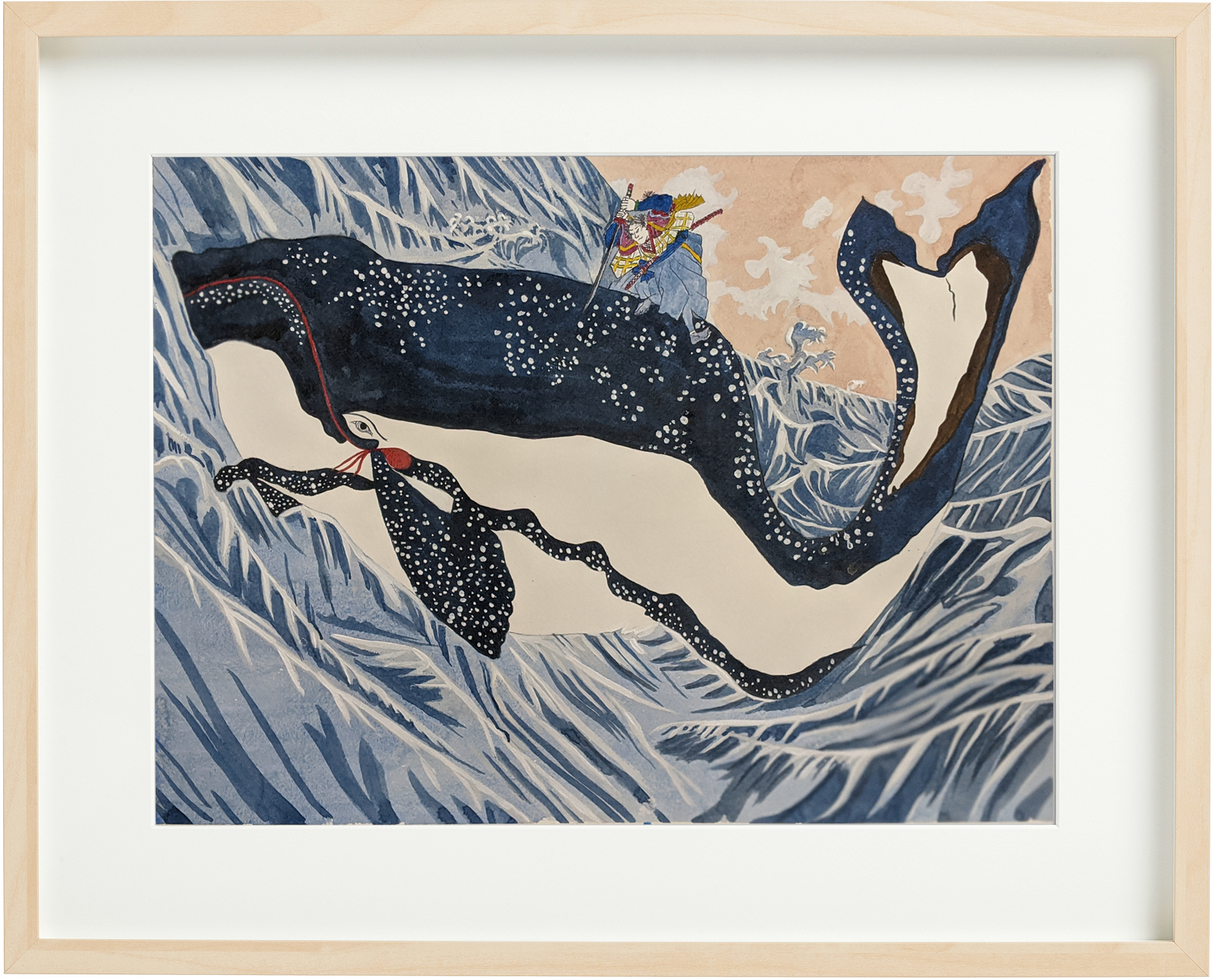
Some images feel like a dare: a small human figure placed beside something so large it refuses to become “background.” A whale that fills the world. A samurai who insists on acting anyway.
This painting—Huge Whale and Musashi Miyamoto—began as a return to an ukiyo-e obsession: Utagawa Kuniyoshi (1798–1861), one of the late masters of the floating world, famous for bold compositions and legendary heroes.

A small figure, a vast body
Kuniyoshi’s famous scene of Miyamoto Musashi confronting a giant whale turns scale into drama: the whale’s body dominates the space, and the human becomes a bright, almost comic punctuation mark inside the storm.
Musashi belongs to that rare category of historical person who feels half-real, half-myth—an early Edo soldier-artist, remembered not only for martial life but for discipline and craft. But the image is the point here, not hero worship. The whale isn’t just an opponent.
It’s the world.
A personal detail: I tried to remove him… and couldn’t
This painting started with a funny disagreement in my own house.
While I was working, my sister—who simply loves whales—said:
“Can you make one without Musashi? Just the whale.”
I understood completely. The whale is so lovable, so magnificent, that the human can feel like an interruption.
But I couldn’t take him out.
Because Musashi is the spark—the tiny, stubborn dot of life that makes the whole composition breathe. In a scene this large, that small figure isn’t “extra.” It’s the hinge the story turns on: the little unreasonable courage that insists on entering the vastness. I left him there, dressed in traditional clothes, because I love that contradiction—serious courage inside a playful picture.
About the painting
-
Original watercolor
-
18” × 24”
-
Unframed