Some paintings are beautiful because of their color. Others are beautiful because of their history. Jade Hall Wealth and Noble belongs to both worlds. Fan Stanbrough’s watercolor interpretation of this subject is not simply a decorative floral painting; it is a contemporary response to one of the most celebrated traditions in Chinese art: the refined, symbolic, and richly layered world of bird-and-flower painting.
The historical source behind this piece is the painting known in the National Palace Museum collection as Wealth and Rank in Halls of Jade, traditionally attributed to Xu Xi of the Southern Tang in the Five Dynasties period. The museum records the work as a silk hanging scroll measuring 112.5 x 38.3 cm. It is one of the rare surviving works associated with an early and formative period of Chinese flower-and-bird painting.
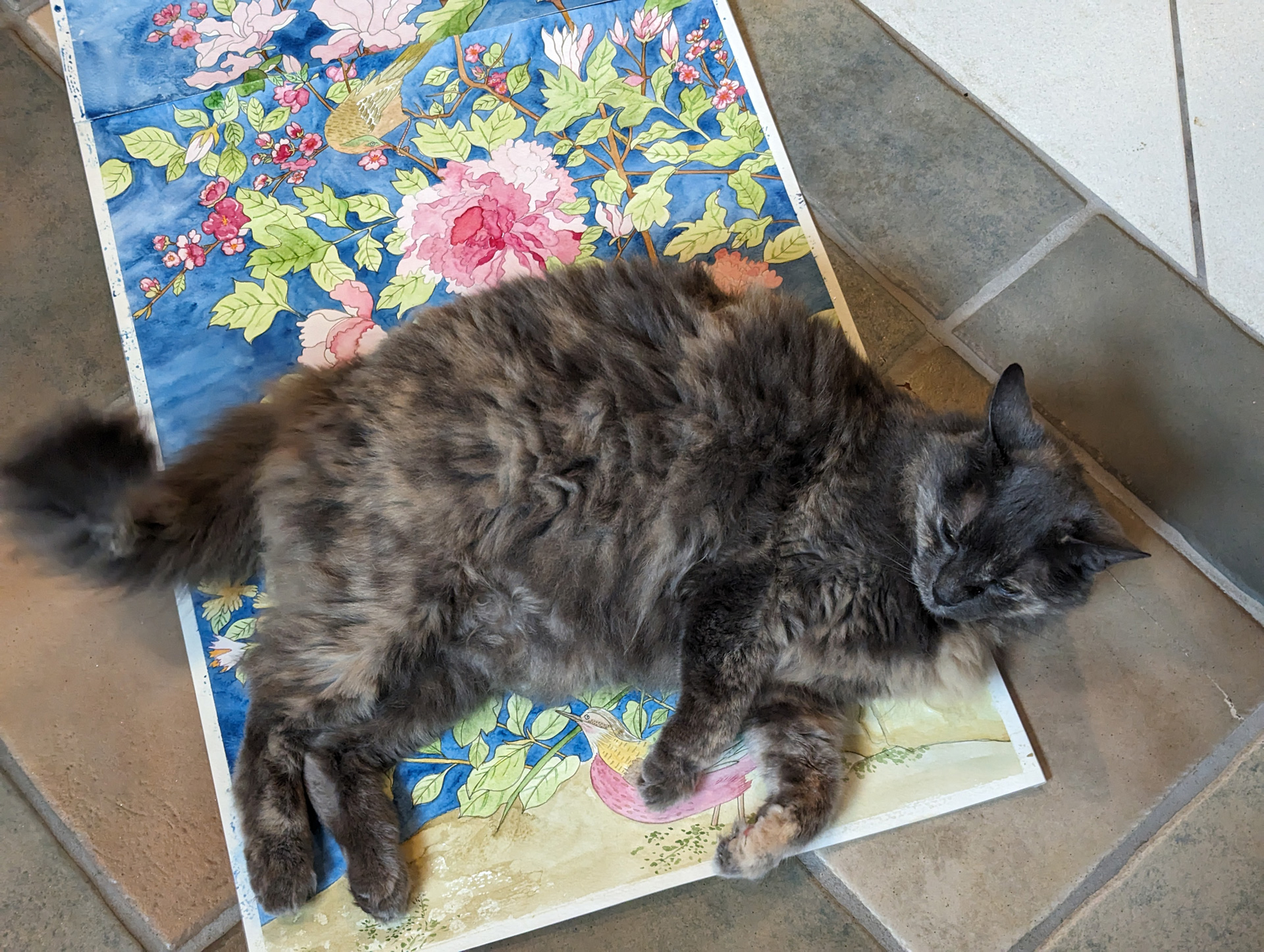
What makes this image so compelling is the abundance of life compressed into a single vertical field. The museum describes a crowded composition of magnolias, peonies, cherry-apple blossoms, decorative rock, and a golden pheasant, all carefully outlined and then filled with opaque color. Rather than leaving breathing room, the painting builds a lush ornamental surface, turning the natural world into a visual field of prosperity, elegance, and ceremonial beauty.
Its title matters as much as its composition. The peony is described as the traditional symbol of wealth and prosperity, long admired in Chinese culture and painting since the Tang dynasty. That symbolism helps explain why the painting feels so full, auspicious, and celebratory. This is not a casual still life. It belongs to a tradition in which flowers and birds were often painted not only for observation, but also for blessing, status, and cultivated pleasure.
The painting is especially important because it is associated with the decorative mode known as 鋪殿花, often translated as “wall-to-wall flowers” or palace-decorating floral painting. The National Palace Museum notes that works in this style were likely used as part of screen paintings or decorative interiors for halls and palace spaces. Their purpose was not modest contemplation from a distance, but visual splendor: dense blossoms, bright mineral color, compressed depth, and a surface designed to radiate abundance. The museum explicitly describes this work as highly decorative and closely connected to that tradition.
Xu Xi occupies an important position in Chinese painting history. The National Palace Museum describes him as a major Southern Tang bird-and-flower painter, and its broader historical overview contrasts the style of Xu Xi in Jiangnan with that of Huang Quan in Sichuan, two figures treated as foundational to the later development of the genre. Museum records also note that historical sources describe Xu Xi as especially skilled at using ink for branches, leaves, and floral structures before applying color, a manner remembered as distinctive within the tradition.
At the same time, this particular work is presented carefully by the museum as attributed to Xu Xi, not unambiguously by him. The museum also notes that the signature in the lower corner may be a later addition. That uncertainty does not diminish the painting’s value; if anything, it deepens its fascination. The work stands not only as an image, but as an object shaped by transmission, collecting, attribution, and centuries of admiration. It carries the aura of history in exactly the way great classical paintings often do.
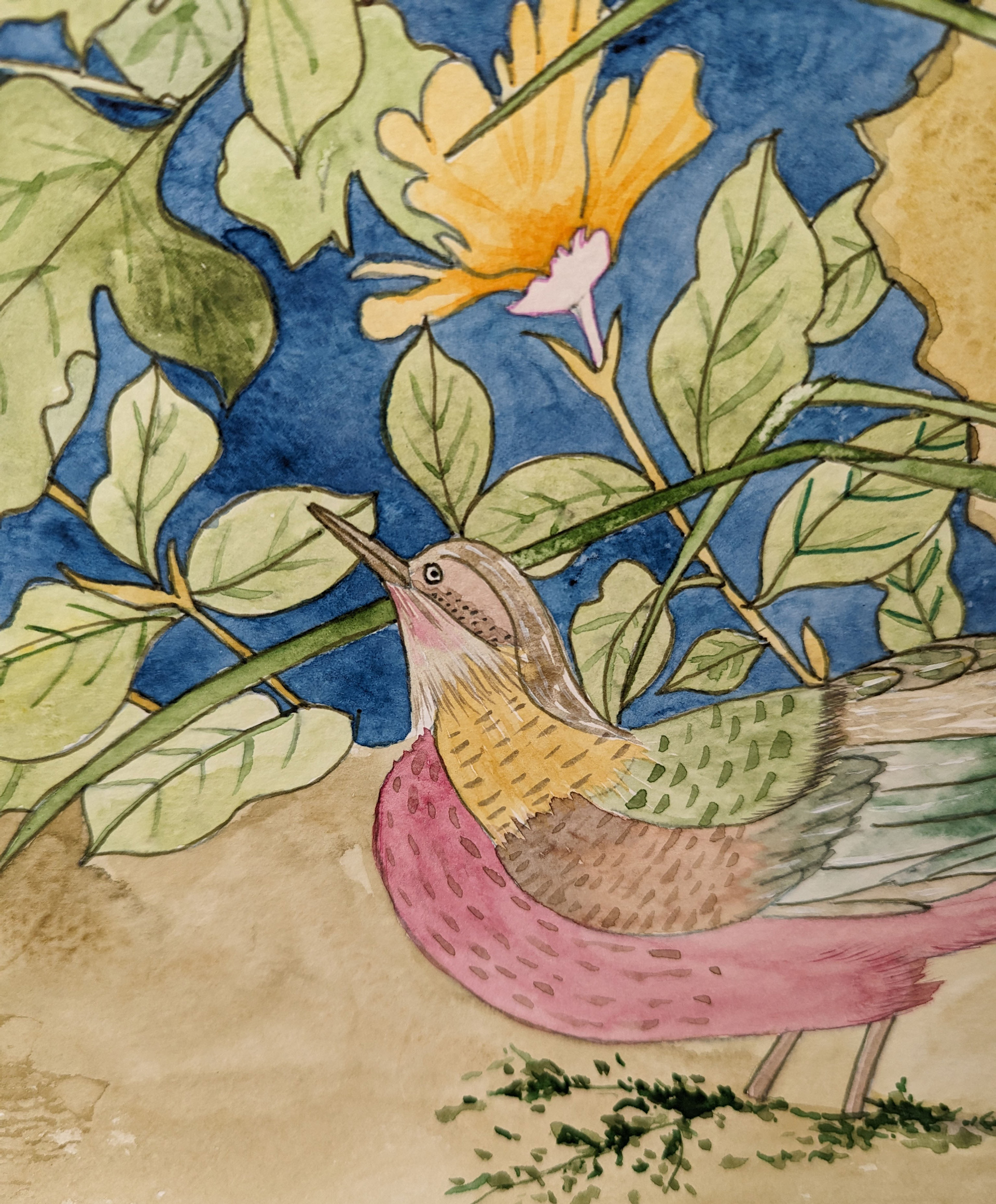
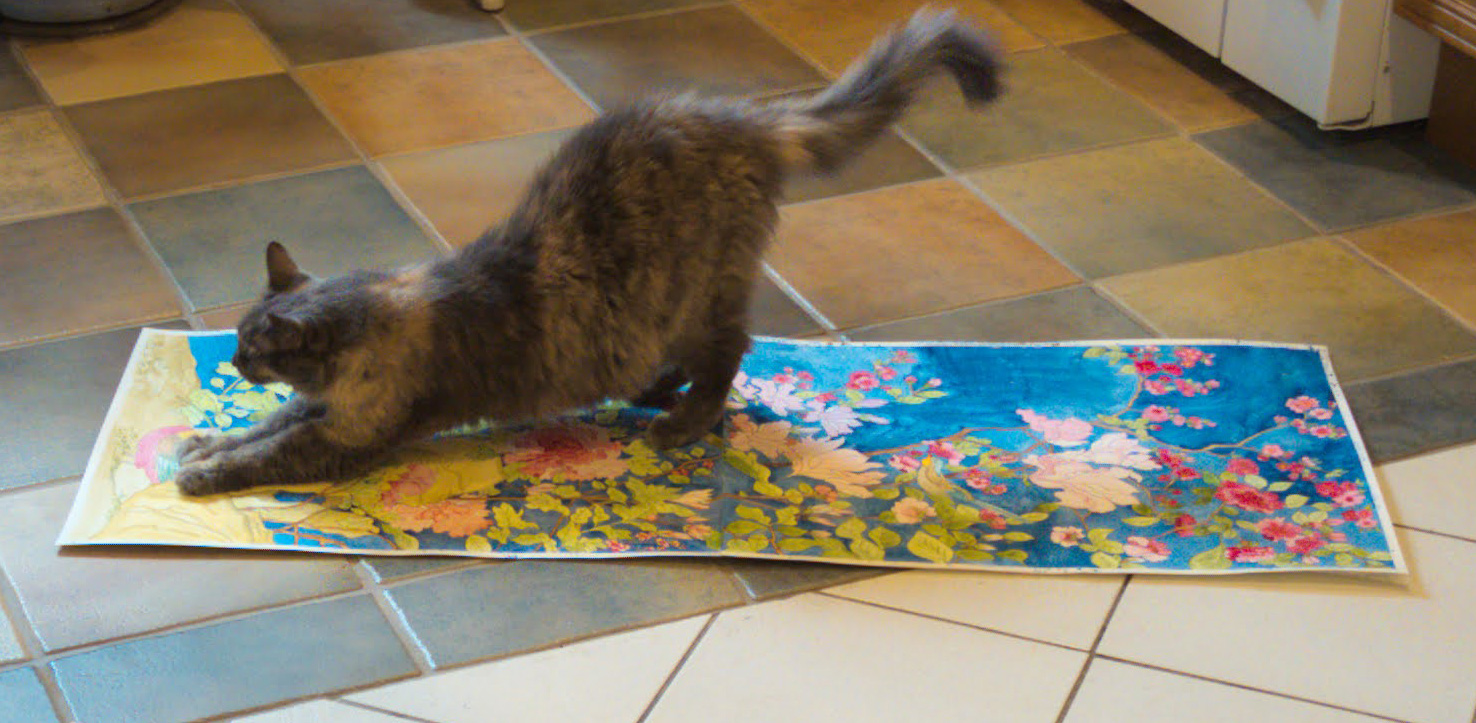
Fan Stanbrough’s watercolor version is not a mechanical copy of an old master. It is a living conversation with a historical image—an effort to absorb the grace, ornament, symbolism, and cultural memory of the original and translate them into a contemporary handmade work. Fan explains that seeing the original left such a strong impression that she felt compelled to create her own rendition. That response is easy to understand: Jade Hall Wealth and Noble is the kind of composition that invites reinterpretation because it is already balancing multiple worlds at once—nature and decoration, realism and pattern, scholarship and pleasure.
For collectors and admirers of Asian art, this watercolor offers more than floral beauty. It offers access to a lineage: the elegance of Southern Tang painting, the opulence of palace decoration, the symbolism of peony and prosperity, and the enduring appeal of bird-and-flower imagery in Chinese visual culture. In a modern home, it can function as a striking vertical statement piece. In a deeper sense, it also carries a story—one that begins over a thousand years ago and continues through the hand of a contemporary artist.
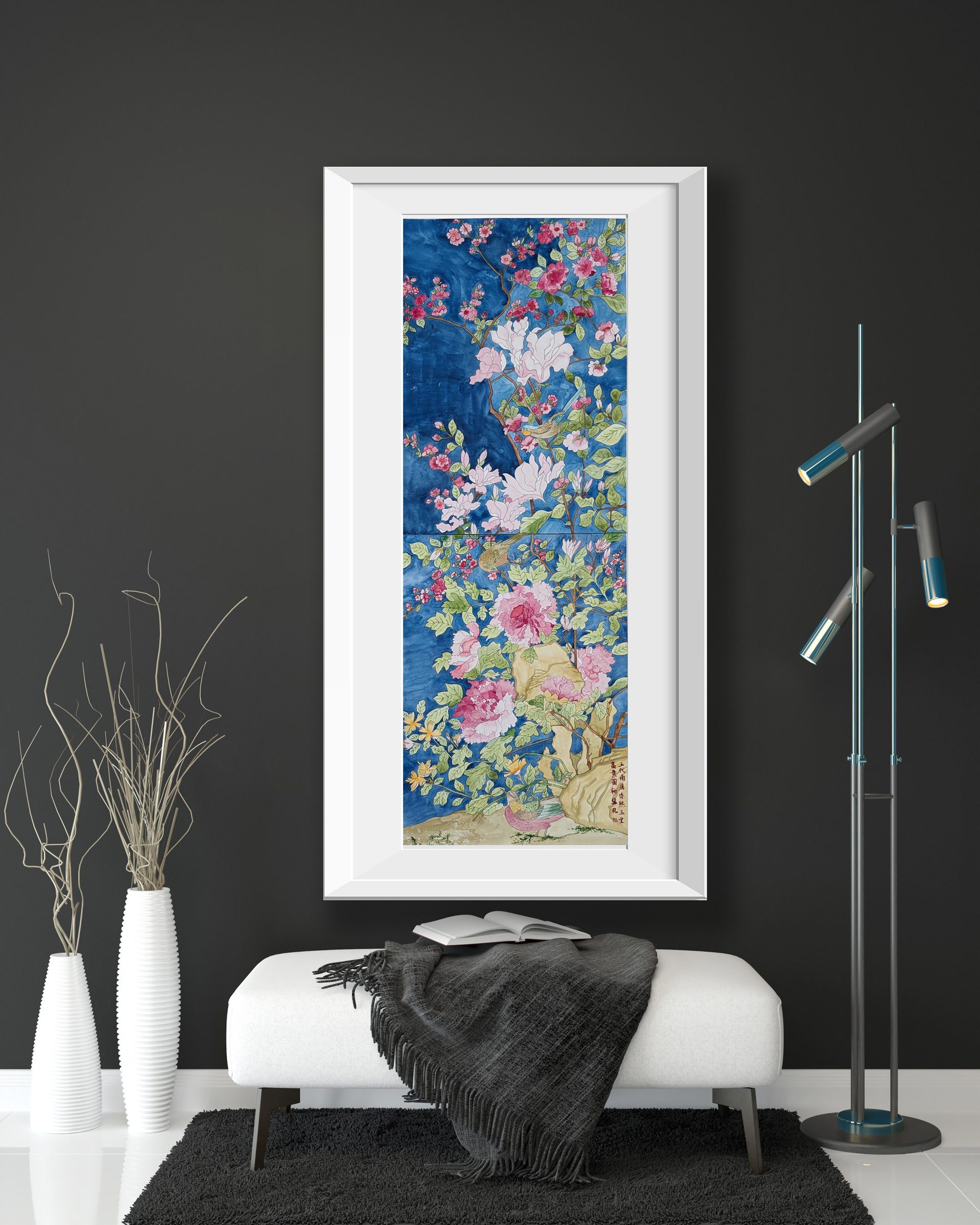
If you are drawn to artwork with both visual richness and cultural depth, Jade Hall Wealth and Noble by Fan Stanbrough is a remarkable choice: a signed watercolor inspired by one of the most sumptuous floral paintings in the Chinese tradition, and reimagined with sensitivity for a new audience. The work is offered as a signed 18″ x 48″ watercolor.