Among the most admired images in the history of Chinese painting is Court Ladies Preparing Newly Woven Silk, known in Chinese as 搗練圖 (Dao Lian Tu), often translated more literally as Picture of Pounding Silk. The work is associated with the Tang painter Zhang Xuan, but the version known today is generally understood to be a Song-dynasty copy or recreation, traditionally attributed to Emperor Huizong of the Northern Song. The surviving scroll is now in the collection of the Museum of Fine Arts, Boston, where it is regarded as one of the museum’s great masterpieces of Chinese painting.
What makes this painting so important is not only its beauty, but the way it condenses several layers of Chinese cultural history into one elegant handscroll: Tang court life, silk production, ideals of feminine refinement, and the long Chinese tradition of preserving lost masterpieces through later copies.
Zhang Xuan and the World of Tang Court Painting
Zhang Xuan is remembered as one of the most famous painters of court ladies in the Tang dynasty, a period often regarded as one of the high points of Chinese civilization. The Tang court cultivated a visual culture of luxury, ceremony, textile richness, and aristocratic elegance, and paintings of women became one of the period’s most refined genres. Later texts and later copies preserve Zhang Xuan’s reputation even though his original works do not survive. Court Ladies Preparing Newly Woven Silk is therefore valuable not only as an image, but as a rare surviving link to that earlier Tang pictorial world.
The Tang dynasty has often been imagined, in both Chinese and global art history, as an age of cosmopolitan confidence and material splendor. In that context, the women in this scroll are not merely anonymous figures performing a task. They belong to a highly cultivated court environment in which clothing, textile labor, and feminine comportment all carried social and symbolic weight.
What Does “Pounding Silk” Mean?
The title can be misunderstood if read too quickly. The “silk” in the title is not simply thread fresh from the loom. The word 練 refers to processed silk cloth that had to be prepared, softened, and finished after weaving. The painting shows women engaged in different stages of that preparation: pounding, arranging, sewing, and stretching or ironing the fabric. In other words, the scroll does not depict a single action, but a sequence of coordinated tasks surrounding the treatment of newly woven silk.
This is one reason the composition feels so alive. The scroll does not depend on a single dramatic event. Instead, it unfolds through labor, gesture, rhythm, and relation. The viewer’s eye moves from one group to the next, almost as if reading a visual sentence about process and refinement.
The Composition: Grace, Labor, and Movement
One of the remarkable features of 搗練圖 is the way it transforms work into choreography. The women are arranged in distinct clusters, each corresponding to a different stage of silk preparation. Yet the painting never feels mechanical. The bodies bend, stretch, sit, and turn in ways that create a flowing visual rhythm across the handscroll.
Art historians and curators have long noted that the image combines elegance with activity. It is a court-ladies painting, but it is not a static portrait of beauty. It is a scene of making. The women do not merely pose; they participate in a process. That tension between aristocratic grace and physical labor is part of what gives the scroll its unusual depth.
The composition is also admired for its subtle handling of space and variation. Later commentary on the work has pointed out that although the subject could easily have become repetitive or overly symmetrical, the painter introduces enough variation in posture, height, and interaction to prevent the scene from becoming rigid. Small details—such as the alternation between standing and seated figures, or the presence of younger attendants—help animate the entire surface.
A Song Copy of a Lost Tang Original
One of the most fascinating things about this painting is that it belongs to a common but crucial phenomenon in Chinese art history: the survival of ancient masterpieces through later copying. The original Tang painting by Zhang Xuan is lost. The extant version is usually described as an early twelfth-century copy, traditionally attributed to Emperor Huizong or to artists working under his courtly authority. This does not make the work secondary in importance. On the contrary, in the Chinese tradition, a faithful and intelligent copy could itself become a major work of art and an essential vehicle of transmission.
Huizong, in particular, occupies a singular position in Chinese art history. He is remembered not only as an emperor, but as an artist, calligrapher, and connoisseur whose court placed enormous emphasis on painting, refinement, and the collection of earlier masterpieces. That the painting is associated with Huizong strengthens its place within the history of imperial collecting and artistic preservation.
From the Old Summer Palace to Boston
The later history of the scroll is also significant. Sources connected with the work state that it was once in the collection of the Old Summer Palace (Yuanmingyuan). After the looting and destruction associated with the 1860 burning of Yuanmingyuan, the painting left China. It was later acquired in 1912 for the Museum of Fine Arts, Boston, by Okakura Kakuzō (Okakura Tenshin), who was then associated with the museum’s Asian department.
That trajectory gives the painting a second history beyond its original subject matter: it also belongs to the modern story of imperial collecting, cultural loss, and the dispersal of Chinese art into major Western museums. For many viewers today, 搗練圖 is therefore both a masterpiece of painting and an object shaped by the global history of collecting and displacement.
Why the Painting Still Matters
Court Ladies Preparing Newly Woven Silk remains compelling because it is more than a record of women at work. It is a meditation on refinement itself. Silk, in Chinese civilization, was not just a material; it was bound up with class, ceremony, beauty, and technical accomplishment. A painting devoted to preparing silk thus carries meanings that are social as well as visual.
At the same time, the work has continued to invite reinterpretation. The MFA has noted that the Chinese title has long been understood simply as Picture of Pounding Silk, while some modern readings have proposed additional emotional or symbolic dimensions related to desire and feminine longing. Whether one emphasizes labor, elegance, or latent emotional meaning, the painting continues to reward close looking because it is poised between surface beauty and deeper cultural suggestion.
A Living Image in Contemporary Reproduction
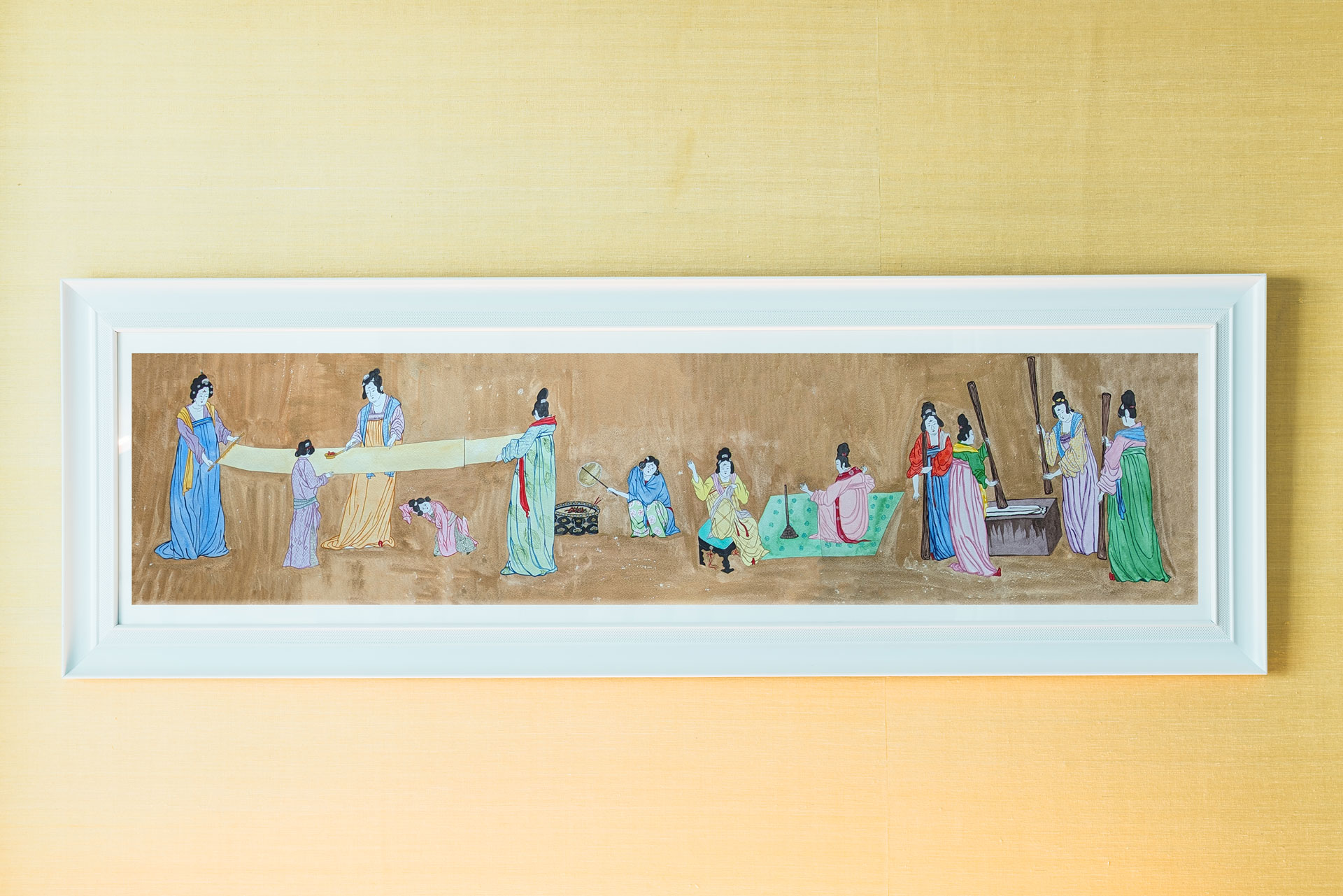
That continuing vitality helps explain why the composition still inspires contemporary artists and reproductions. Fan Stanbrough presents a watercolor reproduction of Court Ladies Preparing Newly Woven Silk, extending the life of a historically layered image into a contemporary handmade medium. In that sense, the modern work participates in a very old East Asian artistic practice: not merely copying the past, but keeping it visible, discussable, and alive.
The original product is listed as 18” x 72” and unframed, giving it the long panoramic feeling that makes scroll-inspired works so distinctive in a home, studio, hallway, or collector’s wall arrangement.
If you are looking for a Chinese court ladies painting, a watercolor reinterpretation of a classical scroll, or a meaningful piece of Asian-inspired wall art, Court Ladies Preparing Newly Woven Silk is well worth a closer look.
Explore the artwork here:
Court Ladies Preparing Newly Woven Silk Chinese: 搗練圖卷 by Fan Stanbrough